Visit deodar-seeds.in



About this variety
Give the seed a cold start, and plan for two sexes
Sea buckthorn seed has internal dormancy that a cold, moist period breaks. The USDA Woody Plant Seed Manual gives 90 days in moist sand at 2–5 °C, or 15 days if the seed is sown in autumn, and records only 6–60% germination on untreated seed after 60 days. The plant is also dioecious: male and female flowers grow on separate plants, pollinated by wind, and only females bear fruit. Grow several seedlings, not one.
Also known as: Seaberry, Sandthorn, Sallowthorn, Leh berry, Chharma, Oblepikha, Sanddorn, Argousier, Olivello spinoso and Elaeagnus rhamnoides.
Sowing
Mix the seed with moist sand and keep it at 2–5 °C, for example in a refrigerator, for 90 days. Then sow about 6 mm deep. The manual runs germination tests on stratified seed for 40 days at alternating 20 and 30 °C. Fresh seed behaves differently: seed collected in Ladakh at 3524 m germinated 71% in 15 days at 22 °C with no cold period (Bhowmik and others, 2013), and a Himachal Pradesh cold-desert trial reached 93% after a 6-day soak in cold water. We do not state the age or origin of this lot, so if in doubt give it the cold period, which costs only time.
How small the seed is
Seeds are 3–5 mm long. The USDA manual counts about 88,000 per kilogram, within a range of 55,000 to 130,000, so a packet of 20 weighs roughly 0.15–0.36 g and a packet of 50 roughly 0.4–0.9 g.
Where it grows, and the risk in hot, wet places
ICRAF lists sea buckthorn from sea level to 5,200 m, in places with 250–800 mm of rain a year. Oregon State rates it hardy to USDA zone 3 or 4, which means winter lows of about −40 to −29 °C. Heat and wet are the weak point. In a reintroduction trial, Ladakh seedlings planted in Shillong and Guwahati had about 20% and 45% survival after two months, lost to heat wilting, cutworms and root rot after heavy rain. We have no sourced sowing month or tested variety for the Indian plains.
Size, sun and fruit
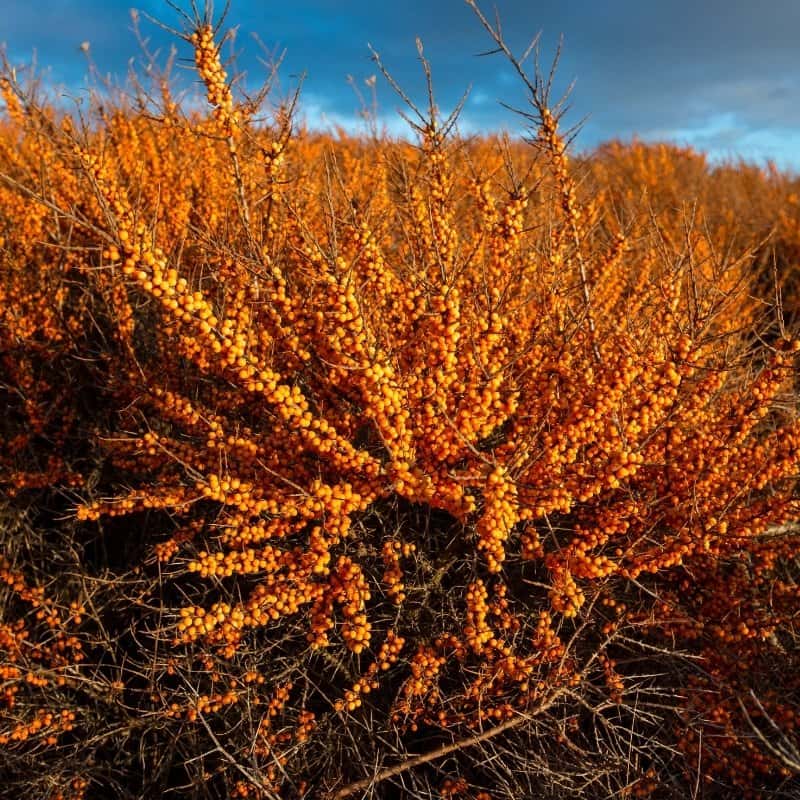
It is a spiny shrub of about 3 m, or a small tree to 9 m (Oregon State); ICRAF reports up to 18 m. It is light-demanding, suckers from the roots and fixes nitrogen with root-nodule bacteria. Oregon State says it tolerates salt and poor soil but needs good drainage. Shrubs usually start to fruit after about three years and reach their best yield after seven to eight years (ICRAF). The fruit is a bright orange berry 6–8 mm long with one brown seed, and it stays on the shrub into the following spring. For good fruit set Oregon State advises six female plants to one male.
Keeping unused seed
Seed is orthodox: the USDA manual reports dry seed kept satisfactorily for 1 to 2 years at room temperature. In a storage trial, Ladakh seed held at 4 °C kept 64% germination after 6 months, while seed held at 27 ± 7 °C in Guwahati had none. Keep what you do not sow sealed and cold.
What the packet is
The packet holds 20 or 50 seeds of Hippophae rhamnoides, sold as Himalayan sea buckthorn. We do not publish a germination percentage, an origin or a seed age for this lot, and no fruit, yield or sex ratio is promised.